
What Probate Covers in Branch County
The Branch County Probate Court is a civil court focused on private rights and on protecting vulnerable people. Its authority comes from the Michigan Constitution, the state Probate and Mental Health Codes, and court rules written by the Michigan Legislature. The court's primary jurisdiction covers estate proceedings, guardianships, and conservatorships. It also hears mental health proceedings and adoptions. Each of these touches property, money, or the care of a person who needs the court's protection. That is why probate files can hold wills, inventories, and orders that appoint someone to act for another.
Probate is one of Michigan's three trial courts, alongside the circuit and district courts. In Branch County, the Probate Court sits at the county courthouse in Coldwater. The Probate Court page describes its mission and jurisdiction in plain terms. Estate and trust work is the daily core of the docket. Guardianship and conservatorship cases add a steady stream of filings for minors, older adults, and people with disabilities. Adoption and mental health matters round out the court's reach.
Most people meet this court after a death or a family crisis. A relative dies and an estate must be settled. An aging parent can no longer handle money or medical choices. A child needs a guardian when parents cannot serve. Each situation opens a different kind of file, yet all of them run through the same court. That single point of contact keeps the process simple for county residents.
Branch County Probate Terms Defined
Probate paperwork uses words that rarely appear in daily life. A short glossary makes the filings easier to read. These terms show up in wills, petitions, and court orders across Branch County estate cases.
- Testator
- A person who makes a will and states who should receive their property after death.
- Executor
- The person named in a will to carry out its instructions and settle the estate.
- Intestate
- Dying without a valid will, so state law decides who inherits the estate.
- Guardianship
- A court arrangement that gives someone authority over the personal care of a minor or an incapacitated adult.
- Conservatorship
- A court arrangement that gives someone authority over the money and property of a protected person.
How Branch County Probate Jurisdiction Shifted
Probate courts in Michigan once held far more than estates. For decades they had exclusive jurisdiction over juvenile delinquency, abuse and neglect, adoptions, estates and trusts, guardianships and conservatorships, and mental commitments. That changed in 1998. The Legislature created a family division within the circuit court. It then moved a large block of work out of probate.
The 1998 shift moved juvenile delinquency, abuse and neglect, adoptions, name changes, emancipation of minors, and waivers of parental consent into the circuit court family division. Branch County's juvenile work now runs through that family division rather than a stand-alone probate juvenile court. The Probate Court still handles the estate, guardianship, conservatorship, and mental health side. This history explains why a search for a juvenile or family record may point to the circuit court instead of probate.
Branch County Probate Court Office
One office handles the county's probate and juvenile filings. It shares the courthouse in Coldwater with the other Branch County courts. Staff route estate, guardianship, and mental health questions to the probate side. Juvenile questions go to a separate unit with its own lines.
Branch County Probate Court
Judge: Kirk Kashian
Probate Register: Marcia Burns
Juvenile Register: Dalyn Cummings
31 Division St.
Coldwater, MI 49036
517-279-4318 (Juvenile Unit 517-279-4316)
Fax: 517-279-6444
Monday through Friday, 8:00 AM to 5:00 PM
Note: The Juvenile Unit keeps its own phone line, so juvenile callers should dial 517-279-4316 rather than the main probate number.
Researching Early Branch County Estate Records
Older estate files did not move online. Early probate estate records survive on microfilm, and they are viewed at the Branch County Clerk office rather than the courtroom. Probate staff must escort researchers to that office, so a call ahead is required. Walk-ins are handled only on a very limited basis. The probate research page lays out the process step by step.
- Call the Probate Court ahead of time to arrange access, since staff must accompany you to the clerk office.
- Visit during the research windows, 9:00 to 11:00 AM or 1:00 to 3:00 PM, Monday through Friday.
- Review the microfilm with staff and mark the pages you need copied.
- Pay one dollar per page, and expect that copy quality is not guaranteed because of the age of the film.
These estate reels sit with the same office that keeps the county's County Clerk records, which is why the research desk and the microfilm live together.
Branch County Probate Record Copy Fees
Probate copy costs in Branch County are modest and easy to plan for. The microfilm copies carry a flat per-page rate. Certifying a record adds a fixed charge. A vital-record search carries its own non-refundable fee.
| Item | Amount |
|---|---|
| Microfilm probate copy, per page | $1 |
| Certify a microfilm record | Additional $10 |
| Vital-record search fee, 10-year search | $20 |
Payment for clerk-held copies is cash or money order only, payable to Branch County Clerk. Personal checks are not accepted and are returned if mailed.
Branch County Juvenile Records and Confidentiality
Juvenile records carry the strongest privacy protection in the probate and family world. Michigan law keeps them closed to the general public. The juvenile confidentiality statute, MCL 712A.28, says the court must keep records of every case brought before it and that those records are open only by court order. Branch County follows that rule for its juvenile files.
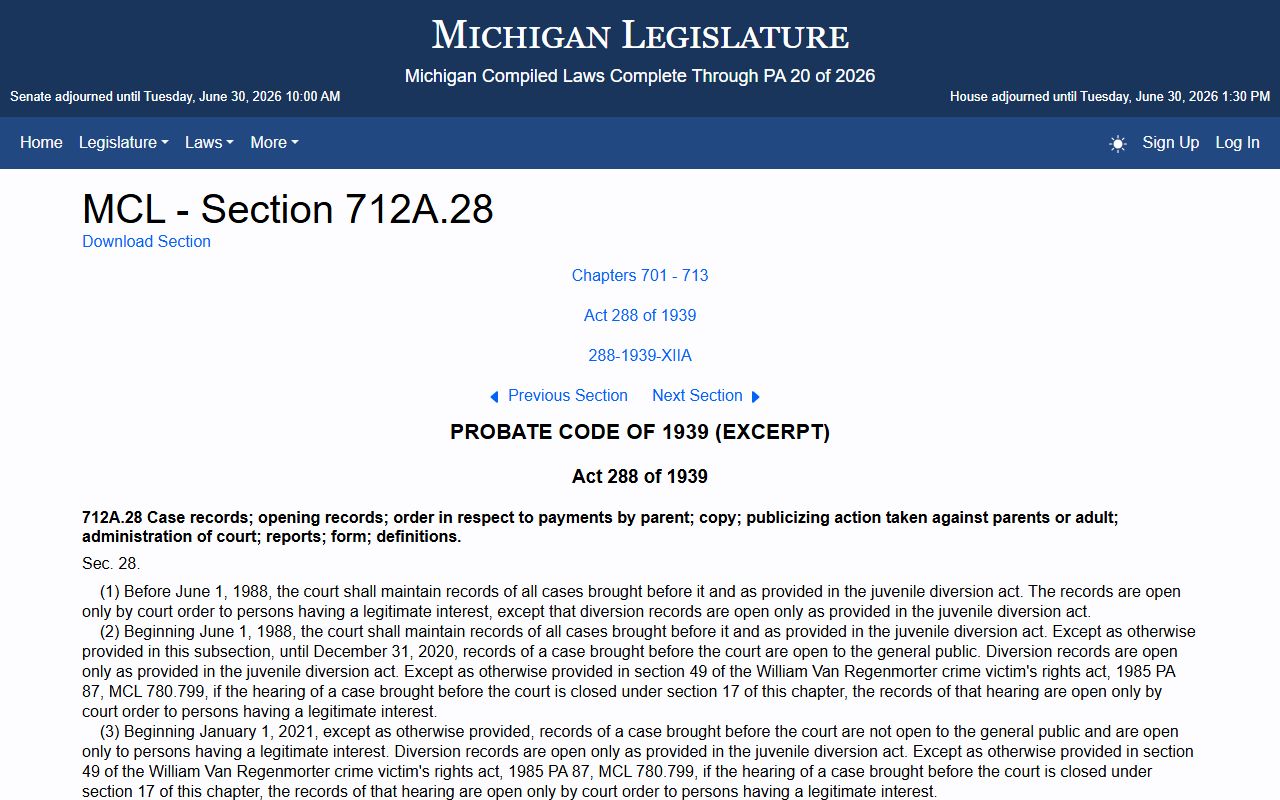
The statute page confirms that juvenile case records stay sealed from casual searches, which is why the county cannot post them online. Remote attendance still keeps a hearing accessible when in-person visits are limited. The phone-only dial-in is 646-876-9923, and the meeting ID is 512 545 9051. The family division page explains how Windows, laptop, and mobile users join a scheduled Zoom hearing.
CASA of Branch County
Some children in abuse and neglect cases get a trained advocate at their side. CASA of Branch County was established in 2008 to help abused or neglected children navigate court. A CASA volunteer is a trained citizen appointed by a judge to represent a child's best interests. The CASA program page lists the qualifications for that role.
Becoming an advocate takes a real commitment. The program screens every applicant before any assignment.
- Be at least 21 years old.
- Complete an application and screening.
- Pass a criminal background investigation.
- Have insured transportation.
- Finish 35 hours of training.
- Commit to 12 to 18 months of service.
What Branch County Probate Records Show
A probate file grows as a case moves forward. Estate files often open with a will or an application to open the estate. From there they gather inventories of property, accountings of money paid and received, and orders that appoint an executor or a personal representative. Guardianship and conservatorship files hold petitions, reports, and orders that name the person given authority. When a will exists, the file names the testator and the person chosen to settle the estate.
Public case information for probate cases can be checked through MiCOURT Case Search, which covers probate alongside civil, criminal, and family matters. The online view is limited to case numbers, party names, and case history. The paper file and certified copies still come from the court or the clerk. When a marriage ends through death rather than divorce, a surviving spouse often opens an estate here, while the underlying marriage and divorce records stay with the county clerk and the state.
A closed estate leaves a lasting paper trail. The final orders show how property was distributed and who received it. Guardianship and conservatorship files track the ongoing reports a guardian or conservator must file each year. Those annual reports let the court confirm that a protected person is safe and that funds are handled properly. For that reason, an estate or protective case can stay active in the record for many years after it opens.
Restricted Branch County Probate Records
Not every probate record is open to a public search. Juvenile files are the clearest example, since state law seals them unless a judge orders otherwise. Mental health proceedings carry strong privacy protections as well, because they involve medical and personal detail. Adoption records are closed to protect the parties. Sealed or suppressed entries can also exist in the state case system, visible to the court but hidden from ordinary searches. For those records, the path is a formal request or a court order rather than an online lookup.
Estate and guardianship files fall on the more open side. A person with a valid reason can usually view a will, an inventory, or an appointment order once a case is filed. Certified copies remain the version that banks, agencies, and other courts accept. When a record is restricted, staff can explain who may qualify to see it and what proof the law requires. That keeps sensitive files protected while still serving the people entitled to them.