
What Is a Court Docket in Branch County
A docket is the official list of everything that has happened in a case, kept in date order. Each line marks one event, such as a filing, a motion, a hearing, or a judge's order. Read together, the entries tell the story of a case from the day it opened to the day it closed. A docket is not the case file itself. It points to documents and describes actions, but the pleadings, exhibits, and signed orders sit in the underlying record.
In this county the docket layer matters because Michigan limits what a court can post online. The public web view is capped at the case number, the party names, and the case history. That history is the docket. It lets a person follow a divorce, a felony, or a small claims dispute without requesting the paper file, as long as the case is public. For most routine tracking, that saved trip is the whole point of checking a docket first.
Dockets differ by court. The 15th Circuit Court publishes its own public docket display, while the broader statewide system carries district, probate, and family case histories for the same courthouse in Coldwater.
How to Find Branch County Dockets Online
Two official routes cover most needs. The 15th Circuit Court page tells the public that case information can now be searched in MiCOURT and links a separate public-docket view for the court's own calendar. For a name or case number lookup across case types, the MiCOURT Case Search is the main tool. It reaches civil, criminal, traffic, domestic and family, and probate cases in the Michigan trial courts.
- Open the MiCOURT Case Search page, or use the public-docket link on the 15th Circuit Court page for its calendar.
- Pick a court and case type, or choose a participant name search.
- Enter a case number if known, or a last name and first name with a date of birth to narrow it.
- Open the case and scroll the case history to read the docket entries in order.
Michigan's trial-court directory helps when the correct court is unclear. The Michigan trial courts overview is shown below.
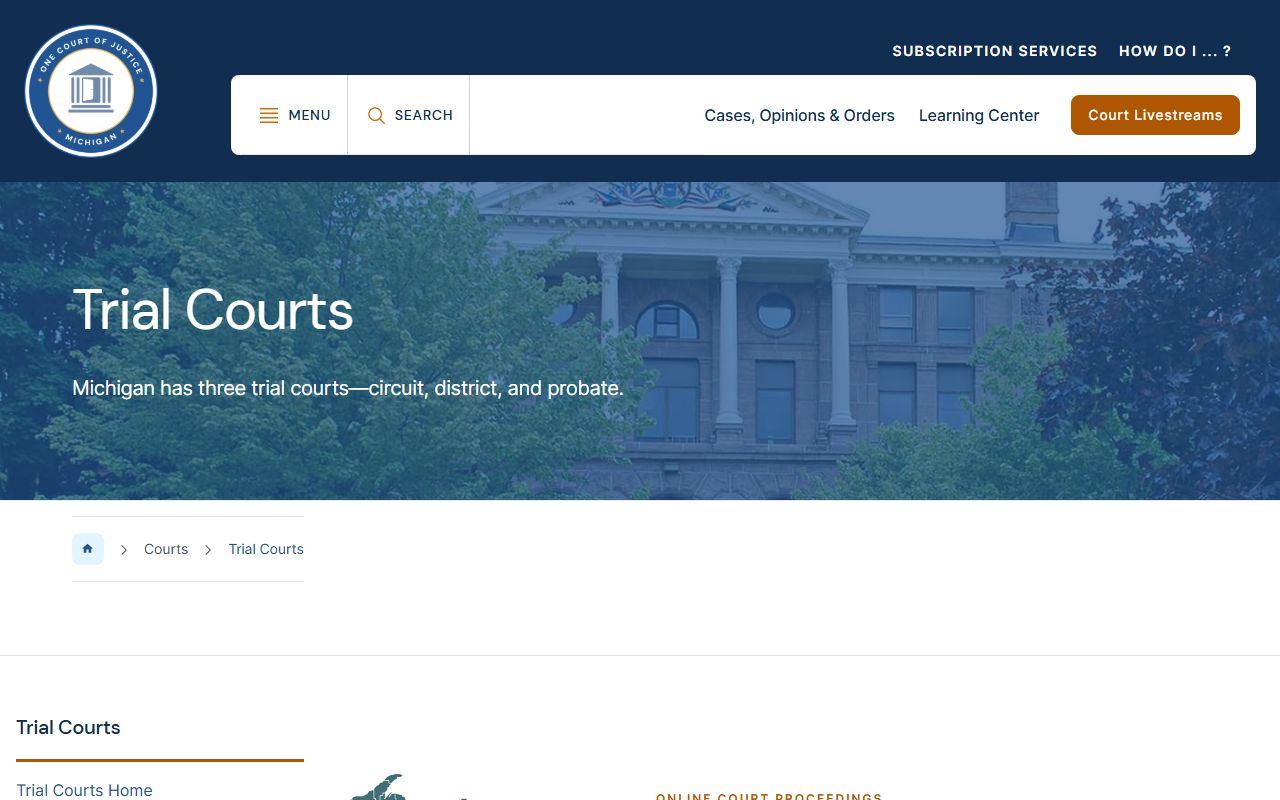
That directory confirms the circuit, district, and probate courts that feed dockets for the Coldwater courthouse, so a Branch County court docket search always begins with one of them.
Sample Branch County Docket Entry
Each docket line packs several pieces of data into one row. The date fixes when the event was recorded. The event type names the action, and the filing party shows who triggered it. A judge or referee is often tied to a hearing, and a result or order notes the outcome. The table below breaks a typical entry into its parts.
| Field | What It Shows |
|---|---|
| Entry Date | The day the event was recorded on the case history |
| Event Type | The action taken, such as a motion, hearing, or order |
| Party Filing | Which side submitted the document or request |
| Judge or Referee | The judicial officer tied to the hearing or ruling |
| Result or Order | The outcome noted for that event |
| Next Hearing | The upcoming date and time when one is set |
| Public Status | Whether the entry is public or suppressed from view |
Not every field appears on every line. A routine filing may show only a date and an event type, while a hearing entry can carry a judge, a result, and the next scheduled date.
Courts That Publish Dockets in Branch County
Three trial courts share the courthouse in Coldwater, and each generates dockets. The circuit court offers the most visible display through its public-docket link, while the district and probate courts feed their case histories into the statewide system. The clerk keeps the underlying files, but the day-to-day event tracking happens online.
- 15th Circuit Court, for felonies, larger civil cases, divorce, and appeals from district court.
- 3-A District Court, for traffic, misdemeanors, small claims, and civil disputes up to $25,000.
- Probate Court, for estates, guardianships, conservatorships, and mental health matters.
Juvenile and family division matters run through the circuit court's family division, but their dockets are not open the way an adult criminal or civil docket is. Access there is controlled by statute, not by a public calendar.
New filings now flow into these dockets electronically. The 3-A District Court went live with MiFILE on June 27, 2024, and attorneys submitting civil filings are required to e-file under Michigan Court Rule 1.109(G)(3)(f). Self-represented parties may e-file but are not forced to. Each accepted filing posts as a fresh docket event, so the online case history updates as a case moves rather than waiting for a paper trip to the counter.
Branch County Circuit Court Motion Days
Docket timing follows a set weekly rhythm at the 15th Circuit Court. Motions are heard on assigned days and times, which makes it easier to predict when a case will next appear on the calendar. Domestic, civil, and personal protection matters are grouped on Friday, while criminal motions are set earlier in the week. The schedule below reflects the court's posted motion days.
| Day | Matter Type | Time |
|---|---|---|
| Monday | Criminal | 8:30 AM |
| Friday | Domestic relations | 8:30 AM |
| Friday | Civil | 10:30 AM |
| Friday | Personal protection orders | 11:00 AM |
The circuit courtroom sits on the southwest end of the second floor of the courthouse. Cell phones are not allowed on the second floor or in the courtroom, so a printed docket or notes are the safer way to track a hearing on site.
Note: Motion days set the pattern, but a specific hearing can be adjourned, so the online case history remains the most current source for a next date.
Docket vs. Full Case Record
People often expect a docket to hand over every document, but the two are different things. A docket is an index of events. The full case record holds the actual complaint, the motions, the exhibits, and the signed orders. The docket is free to browse online for public cases, while the underlying documents usually require a clerk request or a courthouse visit. The comparison below sets the two side by side.
| Docket | Full Case Record | |
|---|---|---|
| Format | Dated list of entries | Complete documents and exhibits |
| Access | Online case history in MiCOURT | Clerk request or in-person review |
| Content | Case number, names, events, dates | Complaint, motions, orders, attachments |
| Use | Track progress and next dates | Legal review and certified copies |
When the docket answers the question, there is no need to pay for a copy. When a signed order or a filed pleading is needed, the full file and copy fees come into play through the Branch County court records request process at the clerk.
Higher-Court and Federal Dockets for Branch County
Not every docket tied to a Branch County case stays at the courthouse. Appeals from the trial courts move to the Michigan Court of Appeals, which keeps its own docket as the state's intermediate appellate court. A case that leaves the 15th Circuit Court on appeal is tracked there rather than in the local calendar.
The appellate court's role is worth understanding before chasing a docket at the wrong level. The Court of Appeals overview is pictured here.
That court reviews trial-court decisions and functions as an error-correcting body, so its docket picks up where the circuit court docket ends.
Federal matters follow an entirely separate track. Branch County sits in the Southern Division of the U.S. District Court for the Western District of Michigan, which maintains federal civil, criminal, and bankruptcy dockets. The Western District of Michigan home page is shown below.
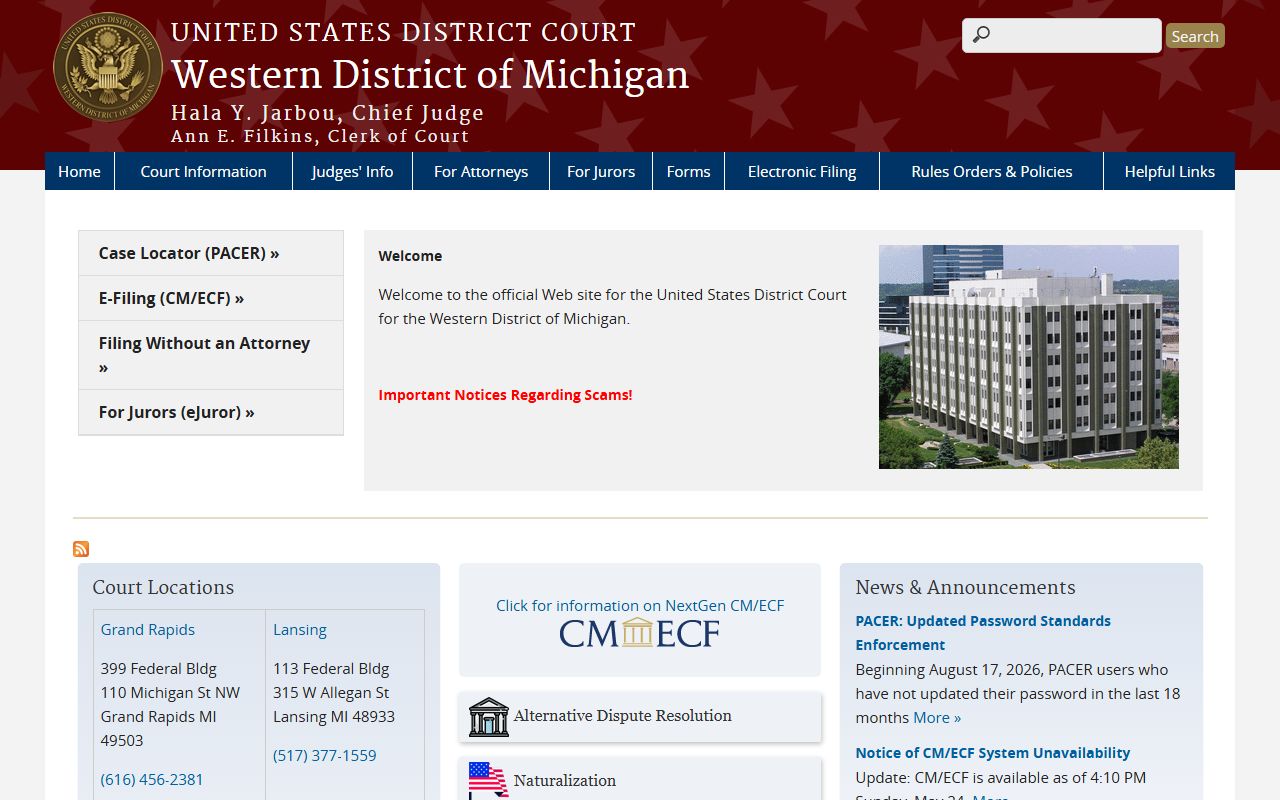
Federal dockets are reached through PACER, the public access system for federal courts. Anyone can register at PACER and search a court directly, or use the case locator when the district is unknown.
Federal appeals from a Branch County case rise to the U.S. Court of Appeals for the Sixth Circuit, not the Michigan Court of Appeals. The Sixth Circuit court overview appears below.
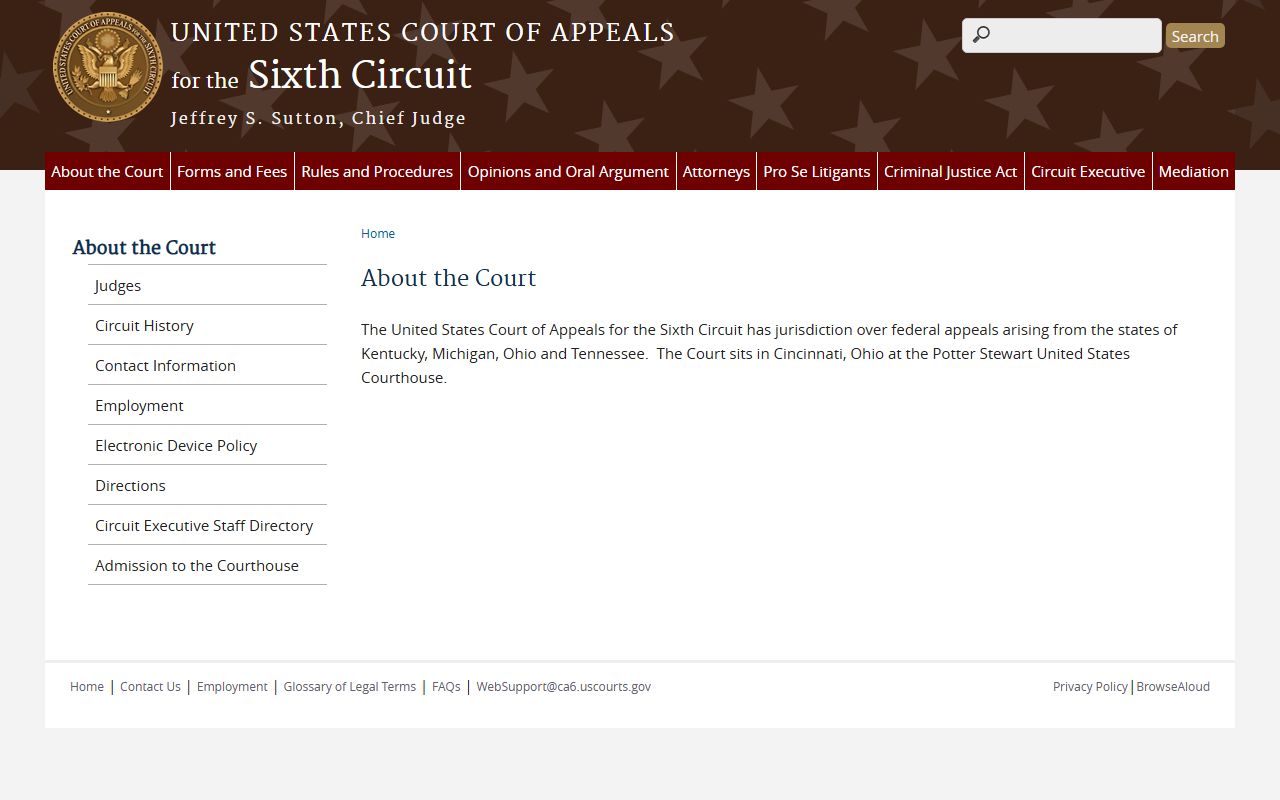
The Sixth Circuit covers Michigan, Ohio, Kentucky, and Tennessee, so a federal appeal from Coldwater is docketed there and viewed through PACER.
How to Read a Branch County Docket
Reading a docket is mostly about knowing the shorthand. Entries lean on abbreviations for common events. A motion is a formal request to the judge. A disposition marks how a case ended, whether by plea, verdict, dismissal, or judgment. An adjournment means a scheduled date was moved. Following those terms down the list turns a wall of entries into a clear sequence.
Access limits shape what shows up. Under the state records-management standards, the public docket carries case data and history, not scanned document images. A suppressed case will not appear in a normal search at all, because Michigan's system flags certain files with a public status that hides them. Juvenile matters are the strongest example, since those records are open only by court order.
Timing is another thing to watch on a docket. Entries post as events are recorded, not always the instant they happen in the courtroom, so a same-day ruling can take a short while to appear. A closed case still keeps its full history, which is useful for confirming a final disposition long after the last hearing. When two people share a name, the date of birth and case type fields are the quickest way to be sure the docket on screen belongs to the right person.
When a docket entry references a document you need, that is the moment to shift from tracking to requesting. The clerk can produce a copy or a certified copy of the filing named in the entry, and the circuit court itself is profiled on the Branch County Circuit Court page.