
How to Search Branch County Court Records
Branch County does not run one flashy countywide case portal. It uses a mix of tools instead. Public case information for the circuit and district courts is searchable through the state's MiCOURT Case Search. The 15th Circuit Court page tells visitors they can now search MiCOURT for public case data and links straight to it. For paper files, copies, and certified documents, the route is a written request to the County Clerk's court record search office.
Pick the tool that fits the need. Use MiCOURT to confirm a case exists or to track its status. Use the clerk request when a stamped copy is required. Have the party name or case number ready before you begin. A birth date or filing year narrows a common name fast.
- Open MiCOURT Case Search and choose a name search or a case-number lookup.
- Enter the last name, or the case number if you already have it.
- Filter by court, case type, and date to trim a long list.
- Open the case to read the docket history and hearing dates.
- If you need a certified copy, mail the clerk's record request form with the fee and a self-addressed stamped envelope.
Requests to the clerk go to Branch County Clerk, 31 Division St., Coldwater, MI 49036. Payment is cash or money order only. Personal checks are returned unpaid.
Searching MiCOURT Case Information
MiCOURT is the public window into Michigan case data, and Branch County plugs into it directly. The public tool covers civil, traffic, criminal, domestic and family, and probate matters. It is more than a name box. The official MiCOURT search reference shows the system can search by case number or by participant name, then filter by case type, status, judge, and a range of dates. Offense dates, disposition dates, and even vehicle plate or driver's license data can narrow a search when a case carries them.
The most useful public fields are shown below. Most searches only need a last name or a case number to start.
| Field | Type | Required | Notes |
|---|---|---|---|
| Last Name | Text | Conditional | Needed unless a case number is entered |
| First Name | Text | Optional | Narrows a common last name |
| Case Number | Text | Conditional | Direct lookup when it is known |
| Case Type / Category | Filter | Optional | Civil, criminal, traffic, family, probate |
| Case Status | Filter | Optional | Open or closed |
| Filing / Offense Date | Filter | Optional | Limits the search to a date range |
| Judge | Filter | Optional | Limits results to one judge's docket |
Note: MiCOURT shows case data and docket history, not scanned documents, so a stamped copy still comes from the clerk's office.
The Branch County Judicial System
Michigan runs what the state calls "One Court of Justice," a design set in the 1963 constitution. It groups every court into one system with one supreme court, one court of appeals, and a set of trial courts. The Michigan judicial branch names three trial courts: circuit, district, and probate. Branch County has all three, and they all sit in the same Coldwater courthouse.
A quick look at the state's overview page helps place Branch County inside that structure.
The full state hierarchy is explained on the state government judicial branch overview, which the image below is drawn from.
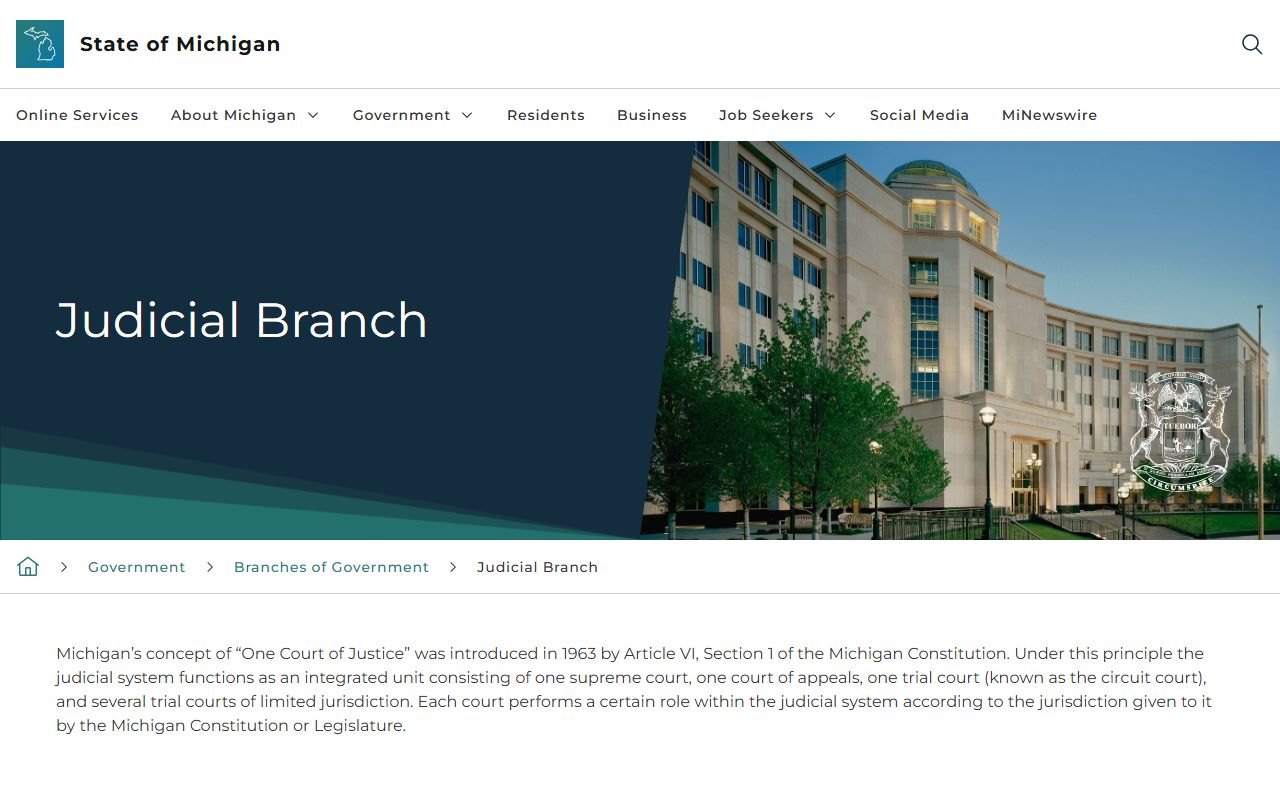
Branch County court records live inside this three-level frame, so a case can move up from the trial court to review. Most matters start and end in the trial courts.
The routing is clean once you know the split. The 3-A District Court takes traffic, most misdemeanors, small claims, landlord-tenant disputes, and civil claims up to $25,000. The 15th Circuit Court takes felonies, larger civil suits, divorce and family support, and appeals from the district court. The Probate Court handles estates, guardianships, mental health cases, and adoptions. Appeals from these trial courts go to the Michigan Court of Appeals, then to the Supreme Court.
Case flow: 3-A District Court › 15th Circuit Court › Michigan Court of Appeals › Michigan Supreme Court
Federal matters follow a different track. Branch County sits in the Western District of Michigan, Southern Division, with appeals to the Sixth Circuit. Those cases never touch the county courthouse.
Comparing Branch County Trial Courts
People often say "court records" when they mean one specific court. The three trial courts do not overlap much. A traffic ticket and a divorce are handled in different rooms by different clerks. The table sorts out which court owns which kind of case, and where the money limits fall.
| Court | Handles | Money Limits | Common Examples |
|---|---|---|---|
| 3-A District Court | Traffic, misdemeanors, small claims, landlord-tenant, lower civil | Civil up to $25,000; small claims up to $7,000 | Tickets, evictions, minor crimes |
| 15th Circuit Court | Felonies, larger civil, domestic relations, appeals | Civil above $25,000 | Divorce, felony trials, district appeals |
| Probate Court | Estates, guardianships, mental health, adoptions | Not set by dollar amount | Wills, conservatorships, commitments |
Criminal cases can touch two of these courts. A felony starts in the district court with a preliminary exam. If the judge finds probable cause, the case is bound over to the 15th Circuit Court for trial. So a single felony file can have a district piece and a circuit piece.
Types of Court Records Available in Branch County
Branch County splits its records into practical buckets rather than one master file. The court pages and the clerk together produce civil, criminal, traffic, domestic relations, probate, juvenile, and vital records. Some sit with a court. Others sit with the clerk. A few live only on microfilm.
The main record types a searcher will meet look like this.
- Criminal records - misdemeanors and felony prelims in district court, felony trials in circuit court.
- Civil records - money disputes, evictions, and small claims, split by dollar amount between the two courts.
- Family and divorce records - divorce, paternity, and support cases handled by the circuit court.
- Probate records - estates, guardianships, and mental health matters through the probate court.
- Traffic records - citations, fines, and waivers held by the 3-A District Court.
- Vital records - marriage, birth, and death records kept by the county clerk.
Not every record is a live online file. Early probate estates survive on microfilm at the clerk's office. Old marriage and court books reach back to the 1830s. Those archives take a different search path than a modern docket.
How to Read Branch County Court Records
Court files use terms that trip up first-time readers. A record can list a charge that never became a conviction. A case can show a plea, a dismissal, or a bindover. Reading a Branch County court record starts with knowing a few plain words. The short list below covers the ones that appear most.
- Plaintiff
- The party who files a civil case, or the state in a criminal one.
- Defendant
- The party accused or sued in the case.
- Arraignment
- The first hearing where a defendant hears the charge and enters a plea.
- Bindover
- The order that moves a felony from district court up to circuit court for trial.
- Disposition
- The outcome of a case, such as a guilty plea, dismissal, or verdict.
- Bond
- Money or a promise that lets a defendant stay out of jail while the case runs.
A charge is not a conviction. It only means the state has accused a person. The disposition tells you how the case ended. Read both before you draw any conclusion.
What Branch County Court Records Show
A public case record in Michigan surfaces more than a case number. The MiCOURT model can show party names, the case type, the judge, the status, and hearing dates. For criminal and traffic matters, offense and disposition dates are part of the record. The visible fields, as returned by a public search, break down like this.
- Case number - the court's unique file identifier.
- Party names - the people or agencies in the case.
- Case type and category - civil, criminal, traffic, family, or probate.
- Judge or referee - the officer assigned to hear the case.
- Status and next hearing - whether the case is open and when it returns.
- Charges or cause - the offense or claim, with offense and disposition dates.
- Case history - the running list of filings and orders.
Public web access stops at that layer. Michigan's records-management standards limit online public records to the case number, party names, and case history. Courts do not post document images on the internet. That is why a search can show a docket line but not the motion behind it. For the full document, you file a request with the clerk.
Public Access Laws for Branch County Court Records
Michigan starts from an open-records default, then adds court rules on top. The Freedom of Information Act sets the state's public-information policy. Court files, though, are governed mostly by court rule and by the records-management standards, which is why a portal can offer a search without offering every page. Juvenile and set-aside records carry their own strict limits.
Key Statutes and Rules:
Michigan MCL § 15.231 - the Freedom of Information Act, which makes public bodies and their records open to the people.
Michigan MCL § 712A.28 - juvenile case records are kept by the court and opened only by court order.
Michigan MCL § 780.621 - the set-aside law, which limits who may see a conviction after it is cleared.
Michigan Court Rule 8.119 - governs public access to court records and the docket entries a court keeps.
The state vital-records rules add a second layer. Anyone may request a certified death, marriage, or divorce record by paying the search fee. Birth records under 100 years old are restricted. Those distinctions drive the marriage and divorce record pages.
Records That Are Restricted or Confidential
Not every court record is open. Some are sealed by law. Others are simply not posted online and take a formal request. The largest restricted group in the county is recent birth records. The clerk releases a birth record under 100 years old only to a person named on it, with proper identification.
- Birth records less than 100 years old.
- Juvenile court files, open only by court order.
- Cases marked suppressed in the MiCOURT public-status filter.
- Set-aside or expunged convictions.
- Records that require a subject or heir to request them.
Important: A case can exist in the court system yet stay hidden from public search when it is suppressed, sealed, or sworn to secrecy by statute.
If all persons named on a restricted birth record have died, an heir or descendant may contact the clerk for instructions. When a birth record reaches 110 years old, a death record is no longer needed to view it. These are the kinds of local rules that a general search cannot show.
MiFILE and Electronic Court Filing
The biggest recent change to Branch County court records is electronic filing. The 3-A District Court went live with MiFILE on Thursday, June 27, 2024. Attorneys filing civil cases must now e-file under Michigan Court Rule 1.109(G)(3)(f). Self-represented parties may e-file too, but they are not forced to. A MiFILE account is free to create.
This matters for records because it changes how new civil files enter the system. More filings arrive digital, which feeds the public docket faster. Older files still sit in paper and microfilm. So a search may find a fresh case online and an old one only at the counter.
Note: MiFILE handles civil filings in the district court, but filing fees still cannot be paid online, and small claims cannot be paid by card.
Specialty Programs and Family Support
Branch County does not run a long list of branded specialty dockets, but two support arms shape family and juvenile cases. The Friend of the Court works for the circuit court on custody, parenting time, and child support. It runs investigations, holds hearings, and offers mediation. It also tracks support enforcement and the bench warrants that follow a missed show-cause hearing.
The Probate Court's family division carries the juvenile work. Judge Kirk Kashian presides over the Juvenile Unit of the 15th Circuit Court, Family Division, which handles delinquency, abuse and neglect, and termination of parental rights. In 1998 the legislature moved most juvenile matters from probate into this circuit family division, which is why juvenile records route the way they do today.
CASA of Branch County rounds out the picture. Started in 2008, it trains volunteers to speak for abused or neglected children in court. Advocates must be at least 21, pass a background check, and finish 35 hours of training. They are appointed by a judge and commit to a case for 12 to 18 months.
Branch County Sheriff and Jail
The Branch County Sheriff's Office runs the county jail, serves court process, provides court security, and keeps local criminal records. Sheriff Fred Blankenship leads the office, with Jason Bingaman as undersheriff. The office and jail sit apart from the courthouse, at 379 Keith Wilhelm Dr. in Coldwater. Administration hours run 8:00 AM to 4:00 PM, while the jail itself operates around the clock.
The county site does not post a public inmate roster or a warrant-search tool. Custody questions go to the jail by phone, and official records come through a records request. For the full custody detail, visitation rules, and deposit methods, see the Branch County inmate records page. For how bench warrants and nonsupport warrants are handled, the warrant records page walks through the phone lines and the fallback chain.
Booking carries fees. The jail charges a $12 booking fee, and anyone booked on a warrant is charged $10 per warrant. Those costs come on top of any bond needed for release.
Marriage, Divorce, and Probate Records
Marriage and probate records sit in two different offices, and divorce straddles both a court and the state. Marriage licenses and certified marriage copies come from the county clerk. Divorce is a circuit-court domestic matter, so the case file lives with the circuit court while certified copies can also come from state vital records. Probate records, from wills to guardianships, belong to the Probate Court. The marriage and divorce records page and the probate records page cover each route in full.
Probate uses a handful of terms worth knowing before a search.
- Testator
- A person who makes a will.
- Executor
- The person named to carry out a will.
- Intestate
- Dying without a valid will.
- Conservator
- Someone the court appoints to manage another person's money.
- Guardian
- Someone the court appoints to care for a person's daily needs.
Early probate estate files are on microfilm at the clerk's office. Viewing them takes a staff escort and a call ahead, so walk-ins are limited.
Genealogy and Historical Court Records
Branch County keeps an unusually long public-record memory. The county clerk holds marriage records from 1833, birth records from 1867, death records from 1867, naturalizations from 1847, and court records from 1833. Nearly all are public, though birth records stay restricted by state law. This deep archive means a search can reach back almost two centuries, even when the live online portal is modest.
The research workflow is hands-on and tightly scheduled. In-office genealogy hours run 9:00 to 11:00 AM and 1:00 to 3:00 PM, Monday through Friday. Space holds only two researchers at a time, and staff ask that children stay home. If a person is deceased, an heir or descendant may reach a birth record by affidavit of heir, and a record 110 years old or older needs no death record to view.
Note: The clerk cannot promise copy quality on the oldest microfilm because of the age of the film, and copies run $1 per page.
Branch County Court Records Fees
The county clerk sets clear fees for searches and copies. A record search covers one case type, civil or criminal, over a 10-year window. Extra years cost more. Copies and certified copies carry their own line items. Payment is cash or money order only, made out to Branch County Clerk. The most common charges look like this.
| Item | Amount |
|---|---|
| Record search, per case type, 10-year period | $10 |
| Each additional year searched | $1 |
| Plain copy, per page | $1 |
| Certified copy | $10 plus $1 per page |
| Vital-record search, 10-year, non-refundable | $20 |
| Certified marriage copy, first copy | $20 |
Traffic fines follow a separate schedule at the district court, and tickets can be paid by mail, in person, online, or by phone through Allpaid using pay location code 6643. Civil and small claims matters cannot be paid by card.
Courthouse Location and Contact
Every court in the county shares one address. The main courthouse at 31 Division St. in Coldwater holds the County Clerk, the 15th Circuit Court, the 3-A District Court, the Probate Court, and the Friend of the Court. The clerk's office is on the first floor. The circuit courtroom sits at the southwest end of the second floor. Doors open at 8:00 AM and close by 4:45 PM.
Branch County Courthouse
31 Division St.
Coldwater, MI 49036
County Clerk: 517-279-4306
15th Circuit Court
31 Division St., 2nd Floor
Coldwater, MI 49036
Phone: 517-279-4304
Court rules on the second floor are strict. Cell phones are not allowed on the second floor or in the circuit courtroom. Shorts and tank tops are barred, and men must remove hats. The district court records its proceedings, and its doors close for business at 4:50 PM.
Frequently Asked Questions
Where do I search for Branch County court cases online?
Start with MiCOURT Case Search, the state's public case tool. The 15th Circuit Court links to it directly. You can search by party name or case number, then filter by case type, status, and date. MiCOURT shows case data and docket history, not scanned documents. For a paper file or a stamped copy, send a written request to the county clerk.
How much does a court record search cost?
The clerk charges $10 to search one case type over a 10-year period, plus $1 for each extra year. Plain copies are $1 per page. A certified copy is $10 plus $1 per page. Payment is cash or money order only, made out to Branch County Clerk. Personal checks are returned unpaid.
Which court handles my case in Branch County?
It depends on the matter. The 3-A District Court takes traffic, most misdemeanors, small claims, and civil claims up to $25,000. The 15th Circuit Court takes felonies, larger civil suits, and divorce. The Probate Court handles estates, guardianships, and mental health cases. A felony can start in district court, then move up to circuit court.
Is there a public inmate roster for the county jail?
No. The county site does not post a public inmate roster or a warrant-search tool. Custody questions go to the jail by phone at 517-278-2325, and official records take a formal request. The inmate records page covers visitation, mail, and deposit methods in detail.
Can I see juvenile court records?
Usually not. Michigan law keeps juvenile case records with the court and opens them only by court order. The probate family division handles these cases, and some hearings run by Zoom, but the underlying records stay confidential. Do not expect a public juvenile file through an online search.
How far back do Branch County records go?
The clerk's archive is deep. Marriage and court records reach back to 1833, birth and death records to 1867, and naturalizations to 1847. Many old files sit on microfilm and take a staffed research visit. Genealogy hours are limited to two researchers at set morning and afternoon windows.
Where are federal cases from Branch County heard?
Branch County is in the Western District of Michigan, Southern Division, with appeals to the Sixth Circuit. Those files are separate from the county courthouse. Federal records are searched through PACER after you register for an account.